
If you predate the video game craze, you might remember annoying your parents by spending money on pinball machines. These days, you can play on a computer if you like. Or you could build one using a microcontroller. But those old machines certainly didn’t have computers in them. At least, not digital ones. Authentic pinball machines were full of relays, solenoids, motors, and leaf switches. [Matt Makai] has the rundown, in three parts, all available now.
Mechanics is the order of the day. The motive force moving the ball? Gravity, of course. Flippers you could control — now a staple — didn’t show up until 1947. How do you sense a ball impact on a bumper? A spoon switch. You can see animations explaining it all.
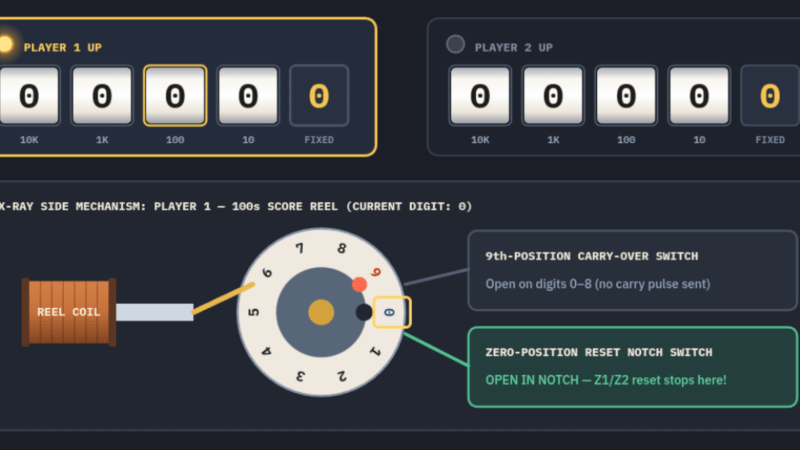
We worked on these old machines, along with their relatives like bowling machines, back in the day. They were both beautiful and terrible. The plastic drums that kept score had a ratchet pawl that let them turn exactly a tenth of a rotation on each score pulse.
These machines were as much art as they were technology. If you get a chance to visit a serious pinball museum (like the one in Las Vegas), it is amazing to walk through time from the very old machines to the more modern ones and see the differences in both electronics and artwork.
Of course, pinball predates even electronics, and if you look at the oldest machines, you’ll understand why it is called pinball. Of course, if they could build a good machine in the 1950s and 1960s, there’s no reason you can’t build one yourself today.


